Loading...
Searching...
No Matches
BT::IfThenElseNode Class Reference
IfThenElseNode must have exactly 2 or 3 children. This node is NOT reactive. More...
#include <if_then_else_node.h>
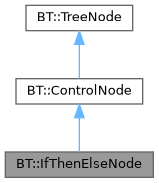
Inheritance diagram for BT::IfThenElseNode:
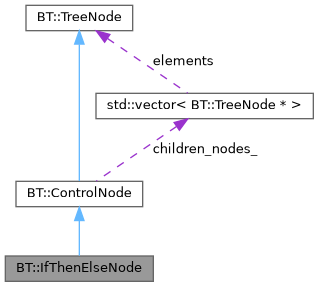
Collaboration diagram for BT::IfThenElseNode:
Public Member Functions | |
| IfThenElseNode (const std::string &name) | |
| IfThenElseNode (const IfThenElseNode &)=delete | |
| IfThenElseNode & | operator= (const IfThenElseNode &)=delete |
| IfThenElseNode (IfThenElseNode &&)=delete | |
| IfThenElseNode & | operator= (IfThenElseNode &&)=delete |
| virtual void | halt () override |
 Public Member Functions inherited from BT::ControlNode Public Member Functions inherited from BT::ControlNode | |
| ControlNode (const std::string &name, const NodeConfig &config) | |
| ControlNode (const ControlNode &)=delete | |
| ControlNode & | operator= (const ControlNode &)=delete |
| ControlNode (ControlNode &&)=delete | |
| ControlNode & | operator= (ControlNode &&)=delete |
| void | addChild (TreeNode *child) |
| The method used to add nodes to the children vector. | |
| size_t | childrenCount () const |
| const std::vector< TreeNode * > & | children () const |
| const TreeNode * | child (size_t index) const |
| virtual void | halt () override |
| void | haltChildren () |
| same as resetChildren() | |
| void | haltChildren (size_t first) |
| void | haltChild (size_t i) |
| virtual NodeType | type () const override final |
| void | resetChildren () |
| Public Member Functions inherited from BT::TreeNode | |
| TreeNode (std::string name, NodeConfig config) | |
| TreeNode main constructor. | |
| TreeNode (const TreeNode &other)=delete | |
| TreeNode & | operator= (const TreeNode &other)=delete |
| TreeNode (TreeNode &&other) noexcept | |
| TreeNode & | operator= (TreeNode &&other) noexcept |
| virtual BT::NodeStatus | executeTick () |
| The method that should be used to invoke tick() and setStatus();. | |
| void | haltNode () |
| bool | isHalted () const |
| NodeStatus | status () const |
| const std::string & | name () const |
| Name of the instance, not the type. | |
| BT::NodeStatus | waitValidStatus () |
| virtual NodeType | type () const =0 |
| StatusChangeSubscriber | subscribeToStatusChange (StatusChangeCallback callback) |
| subscribeToStatusChange is used to attach a callback to a status change. When StatusChangeSubscriber goes out of scope (it is a shared_ptr) the callback is unsubscribed automatically. | |
| void | setPreTickFunction (PreTickCallback callback) |
| void | setPostTickFunction (PostTickCallback callback) |
| void | setTickMonitorCallback (TickMonitorCallback callback) |
| uint16_t | UID () const |
| const std::string & | fullPath () const |
| const std::string & | registrationName () const |
| registrationName is the ID used by BehaviorTreeFactory to create an instance. | |
| const NodeConfig & | config () const |
| template<typename T > | |
| Result | getInput (const std::string &key, T &destination) const |
| template<typename T > | |
| Expected< Timestamp > | getInputStamped (const std::string &key, T &destination) const |
| getInputStamped is similar to getInput(dey, destination), but it returns also the Timestamp object, that can be used to check if a value was updated and when. | |
| template<typename T > | |
| Expected< T > | getInput (const std::string &key) const |
| template<typename T > | |
| Expected< StampedValue< T > > | getInputStamped (const std::string &key) const |
| template<typename T > | |
| Result | setOutput (const std::string &key, const T &value) |
| setOutput modifies the content of an Output port | |
| AnyPtrLocked | getLockedPortContent (const std::string &key) |
| getLockedPortContent should be used when: | |
| StringView | getRawPortValue (const std::string &key) const |
| void | emitWakeUpSignal () |
| Notify that the tree should be ticked again() | |
| bool | requiresWakeUp () const |
Additional Inherited Members | |
| Public Types inherited from BT::TreeNode | |
| typedef std::shared_ptr< TreeNode > | Ptr |
| using | StatusChangeSignal = Signal< TimePoint, const TreeNode &, NodeStatus, NodeStatus > |
| using | StatusChangeSubscriber = StatusChangeSignal::Subscriber |
| using | StatusChangeCallback = StatusChangeSignal::CallableFunction |
| using | PreTickCallback = std::function< NodeStatus(TreeNode &)> |
| using | PostTickCallback = std::function< NodeStatus(TreeNode &, NodeStatus)> |
| using | TickMonitorCallback = std::function< void(TreeNode &, NodeStatus, std::chrono::microseconds)> |
| Static Public Member Functions inherited from BT::TreeNode | |
| static bool | isBlackboardPointer (StringView str, StringView *stripped_pointer=nullptr) |
| Check a string and return true if it matches the pattern: {...}. | |
| static StringView | stripBlackboardPointer (StringView str) |
| static Expected< StringView > | getRemappedKey (StringView port_name, StringView remapped_port) |
| template<class DerivedT , typename... ExtraArgs> | |
| static std::unique_ptr< TreeNode > | Instantiate (const std::string &name, const NodeConfig &config, ExtraArgs... args) |
| Protected Types inherited from BT::TreeNode | |
| using | PreScripts = std::array< ScriptFunction, size_t(PreCond::COUNT_)> |
| using | PostScripts = std::array< ScriptFunction, size_t(PostCond::COUNT_)> |
| Protected Member Functions inherited from BT::TreeNode | |
| NodeConfig & | config () |
| virtual BT::NodeStatus | tick ()=0 |
| Method to be implemented by the user. | |
| void | resetStatus () |
| Set the status to IDLE. | |
| void | setRegistrationID (StringView ID) |
| void | setWakeUpInstance (std::shared_ptr< WakeUpSignal > instance) |
| void | modifyPortsRemapping (const PortsRemapping &new_remapping) |
| void | setStatus (NodeStatus new_status) |
| setStatus changes the status of the node. it will throw if you try to change the status to IDLE, because your parent node should do that, not the user! | |
| PreScripts & | preConditionsScripts () |
| PostScripts & | postConditionsScripts () |
| template<typename T > | |
| T | parseString (const std::string &str) const |
| Protected Attributes inherited from BT::ControlNode | |
| std::vector< TreeNode * > | children_nodes_ |
Detailed Description
IfThenElseNode must have exactly 2 or 3 children. This node is NOT reactive.
The first child is the "statement" of the if.
If that return SUCCESS, then the second child is executed.
Instead, if it returned FAILURE, the third child is executed.
If you have only 2 children, this node will return FAILURE whenever the statement returns FAILURE.
This is equivalent to add AlwaysFailure as 3rd child.
Member Function Documentation
◆ halt()
|
overridevirtual |
The method used to interrupt the execution of a RUNNING node. Only Async nodes that may return RUNNING should implement it.
Reimplemented from BT::ControlNode.
The documentation for this class was generated from the following file:
- include/behaviortree_cpp/controls/if_then_else_node.h